Find detailed and scientific information here about Bursa Osmangazi teeth whitening methods, in-office and at-home applications, and the treatment process.
The appearance of our teeth when we smile is one of the first details that stands out in our daily communication. However, over time, color changes may occur in tooth enamel due to foods consumed, age, or genetic predispositions. If you are researching Bursa Osmangazi teeth whitening options, let’s take a detailed look at how this process works, what methods are available, and why a dentist’s supervision is essential.
This article has been prepared to inform the public about teeth whitening (bleaching) treatment and includes current dental approaches for 2026.
There are two different mechanisms behind tooth discoloration: extrinsic staining and intrinsic discoloration. The structure of tooth enamel has microscopic pores that are not visible to the naked eye. Foods consumed during the day settle into these pores and gradually dull the tooth’s natural color.
The main factors that cause tooth discoloration are:
Tea and Coffee Consumption: They adhere quickly to tooth enamel due to the tannins they contain.
Tobacco Products: Nicotine and tar settle into the porous structure of the enamel, leading to permanent yellow/brown stains.
The Aging Process: As age advances, the outer transparent enamel layer wears down and the yellowish dentin layer underneath becomes more visible.
Medications Used During Childhood: Some antibiotics used during tooth development, especially tetracycline group antibiotics, cause gray-yellow discoloration in the tooth’s internal structure.
Genetic Makeup: Each individual’s natural tooth color, like skin color, varies.
In clinics in Bursa’s Osmangazi district, your dentist determines the source of this discoloration before planning treatment. Because the treatment process for an intrinsic discoloration is completely different from that of an extrinsic stain.
Many people confuse tartar cleaning (scaling) with teeth whitening (bleaching). Tartar cleaning is the mechanical removal of hardened plaque and superficial stains that adhere to the tooth surface in order to protect gum health. This procedure does not lighten the tooth’s natural color; it only removes the layer of dirt on it.
Teeth whitening, on the other hand, is the process of lightening the color pigments in the tooth’s chemical structure by means of oxygenation, using special gels (hydrogen peroxide or carbamide peroxide) that penetrate the enamel and dentin layers of the tooth. True shade lightening is only possible through bleaching.
The whitening methods used in dentistry are basically grouped under three main headings. Which method is suitable for you should be decided together with your dentist after a clinical examination.
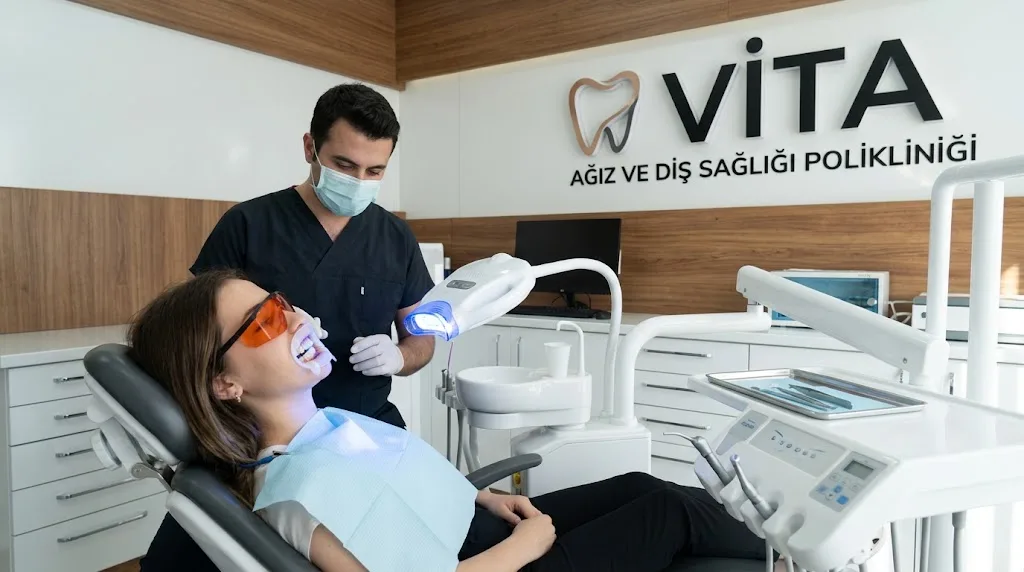
In-office whitening is a method performed in the dental chair and entirely under the dentist’s control. The application process includes the following steps:
The dentist first applies and hardens a protective barrier to protect the gums. This prevents the whitening gel from coming into contact with the soft tissues.
A high-concentration whitening gel is carefully applied to the front surfaces of the teeth.
To activate the active ingredients in the gel, a special light source (laser, halogen, or LED devices) is directed at the teeth for a certain period of time.
The procedure is usually repeated 2 or 3 times on the same day in 15-20 minute sessions, depending on the desired result and the tooth’s response.
This method is often preferred because it acts quickly and is carried out under the dentist’s supervision. However, expectations should be shaped according to individual tooth structure; every tooth has a different whitening capacity.
Despite its name, the at-home method is not carried out with random products bought from a pharmacy, but rather through a medical process guided by the dentist:
Your dentist takes your mouth impression and prepares custom-made transparent trays that fit your teeth perfectly.
These trays are filled with gels containing carbamide peroxide at a lower concentration than in in-office treatment.
The trays are worn in the mouth for the period specified by the dentist (usually 4-8 hours a day or during nighttime sleep).
The process is completed within 1 to 3 weeks, depending on the patient’s use.
This is the use of both methods together in cases with advanced discoloration or when the achieved result is desired to be maintained for a long time. After the procedure performed by the dentist in the clinic, reinforcement is provided with at-home trays.
Teeth whitening is a medical procedure and may not be suitable for everyone. For the procedure to be performed, the patient’s oral health must meet certain conditions:
Gum Health: The patient should not have active gum bleeding, recession, or infection. If present, periodontal (gum) treatment is applied first.
Caries Control: There should be no untreated cavities in the mouth. If the gel reaches the tooth nerve (pulp) through decayed tissue, it may cause severe pain.
Age Limit: Since the enamel layer and pulp chamber are still developing, it is generally not medically recommended for individuals under 18.
Pregnancy and Breastfeeding: Since there are not enough clinical studies conducted on pregnant and breastfeeding mothers, whitening should be postponed during these periods.
Existing Restorations: Porcelain veneers, zirconium crowns, or composite fillings do not whiten with these gels. The procedure is effective only on natural tooth tissue. If you have a filling in the front region, it may need to be replaced so that it matches your teeth’s new shade after whitening.
The most important factor determining the longevity of the whitening process is the care the patient shows after the procedure.
Before the procedure, a comprehensive oral examination must definitely be performed, tartar should be removed if present, and the tooth surface should be polished. A gel applied to an unprepared tooth cannot show sufficient effect.
After the procedure, the pores in the tooth enamel remain open for a while longer. Therefore, the “colored diet” rule must be strictly followed for the first 2-3 days (indeed, ideally the first 1 week).
Colored beverages such as tea, coffee, sour cherry juice, turnip juice, and red wine should not be consumed.
Foods such as tomato paste, soy sauce, curry, and red beet should be avoided.
Using tobacco products can reverse the achieved result in a very short time.
Does teeth whitening damage the teeth?
When performed under dentist supervision, with the correct indication, and with medical materials approved by the Ministry of Health, it does not cause structural damage to the enamel or internal structure of the tooth. The gels only break down and remove color molecules.
Is sensitivity after the procedure normal?
Yes, mild to moderate sensitivity to cold and heat for the first 24-48 hours is an expected condition. This is temporary. If your dentist deems it necessary, they can help you get through this period more comfortably by applying fluoride or desensitizing agents after the procedure.
How long does the achieved whiteness last?
This period depends entirely on the person’s diet, saliva structure, and oral care habits. In some patients, the effects begin to diminish within 6 months, while in those who pay attention to oral hygiene and avoid staining foods, it can be preserved for 1 to 2 years.
Do whitening toothpastes sold in pharmacies work?
Most whitening toothpastes sold in markets or pharmacies clean surface stains by scraping them off with the help of granules (abrasives) they contain. However, with long-term and unconscious use, they may scratch the enamel and cause the teeth to stain more quickly. They do not provide true chemical whitening.
Due to legal regulations, fixed or competitive pricing cannot be shared for healthcare services. However, when researching Osmangazi teeth whitening prices, knowing the factors that affect the cost helps you choose the right clinic.
Main factors determining the pricing:
The type of method to be applied (in-office, at-home, or combined).
The brand and content of the whitening gel to be used.
How many sessions the treatment will take.
The minimum fee schedule set for that year by the Turkish Dental Association (TDA).
Making a research focused not on price but on material quality and the dentist’s case experience is of great importance for protecting your oral health.
This page content is intended solely to enlighten the public on health matters within the scope of Law No. 1219 on the Practice of Medicine and Branches of the Medical Profession and the relevant Regulation on Promotional and Informational Activities in Health Services. The information provided here cannot be used for the diagnosis or treatment of diseases and is not of a guiding or demand-generating nature. To obtain definitive information about your tooth color and the most suitable treatment method for you, please consult your dentist directly.
Let us take a look together and go over your treatment options. Feel free to call us with any questions.
 Türkçe
 English